How many security cameras for a 4,000 sq ft house with 2 exterior doors?
A 4,000 sq ft home with 2 exterior doors typically needs about 12 cameras: 9 outside and 3 inside. That is one camera per exterior door, one wide camera covering roughly every three reachable ground floor windows, and one on the driveway or garage. At 4K that system fills a 4 TB drive in about 4.8 days and needs a PoE budget of about 185 W.
How this is worked out
cameras = exterior doors + (reachable ground floor windows / 3) + driveway + (floor area / 1,500 for interior)
This is a CONVENTION and not a standard. It is built on entry points rather than on floor area because burglars use doors and reachable windows, not square footage. Treat it as a sound starting point to adjust against your own property rather than as a rule.
| Position | Cameras | Why it earns a camera |
|---|---|---|
| Exterior doors | 2 | Every door is an entry point, and the front door is where almost every legitimate interaction happens too. |
| Ground floor windows | 6 | About 16 reachable windows, and one wide lens covers roughly three adjacent ones. |
| Driveway or garage | 1 | Vehicles, deliveries and approach warning, and the one position where a plate might be readable. |
| Interior | 3 | A single interior camera covering the main circulation route records anyone who got past the exterior. |
| Total | 12 | Sized to an eight channel recorder if this is eight or fewer, sixteen otherwise. |
| Decision | What this system needs | Why |
|---|---|---|
| Recorder channels | 16 channel | Buy the next size up from your camera count so an addition does not mean a new recorder. |
| PoE budget (class 3) | 185 W | IEEE 802.3af reserves 15.4 W per port regardless of what the camera draws. |
| Drive for 14 days at 4K | 11.7 TB | Continuous recording, H.265, typical bitrate. |
| Drive for 30 days at 4K | 25.1 TB | The usual insurance and police request window. |
| Upload if cloud recorded | 72 Mbps | Which is why this many cameras is a local recording job. |
Count entry points, not square feet
Floor area is a poor predictor of how many cameras a house needs. A long narrow 4,000 sq ft house with 2 doors and a single approach needs fewer cameras than a compact one on a corner plot with access from two streets. What matters is how many ways there are in, and how many separate approaches lead to them.
Walk the property and count the ways you could get to each door without being seen from the street. Those routes are what the cameras are for, and it is common to find that one well placed camera covers two of them.
Where the count is usually wrong
Too many cameras pointed at the same open area, and none covering the side return, the back gate or the garage door. Overlapping coverage feels thorough and adds almost nothing, while a single uncovered approach makes the whole system defeatable by anyone who notices it.
The other common error is putting every camera high under the eaves. A camera at 3.5 metres pointed down at a steep angle records the top of everyone's head, which identifies nobody. Mounting at around 2.5 to 3 metres, just out of easy reach, gives a far more useful angle on a face.
Systems sized for about 12 cameras
Ordered by how closely the included camera count matches the 12 this property suggests.
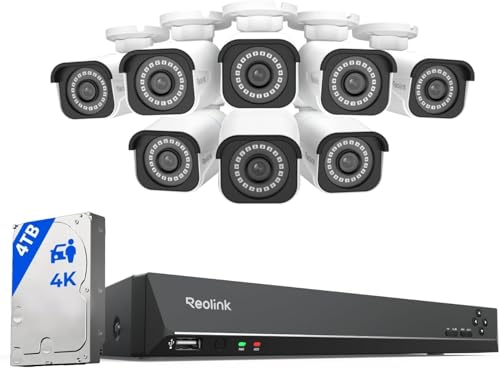
REOLINK 16CH 4K Security Bullet Camera System with 4TB HDD RLK16-800B8
$1,259.99Sixteen channels with eight 4K bullets and a 4TB drive, so there are eight spare channels for later without replacing the recorder.
- Channels
- 16
- Cameras included
- 8
- Resolution
- 8 MP
- Drive included
- 4 TB
Prices change often.

REOLINK 16CH 4K Security Dome Camera System with 4TB HDD RLK16-800D8
$1,259.99The dome bodied version of the same sixteen channel system, which is harder to knock out of alignment and reads as less aggressive on a residential street.
- Channels
- 16
- Cameras included
- 8
- Resolution
- 8 MP
- Drive included
- 4 TB
Prices change often.
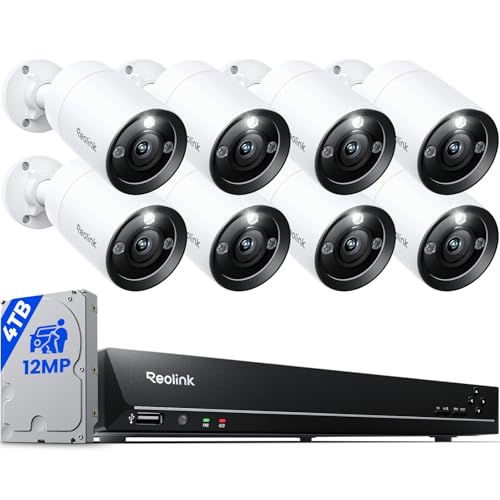
REOLINK 16CH 12MP Security Bullet Camera System with 4TB HDD RLK16-1200B8-A
$1,499.99Twelve megapixel sensors put roughly 4,512 horizontal pixels across the scene instead of 3,840, which is the difference between recognising and identifying someone at the end of a long drive.
- Channels
- 16
- Cameras included
- 8
- Resolution
- 12 MP
- Drive included
- 4 TB
Prices change often.

Swann AdvancedX Wired NVR 4K Security Camera System, 8 Channels, 8 PoE Cameras
$749.99All eight channels populated at once, which is the cheapest cost per camera in this catalog for a fully loaded eight channel recorder.
- Channels
- 8
- Cameras included
- 8
- Resolution
- 8 MP
- Storage
- Local NVR
Prices change often.
Common questions
How many security cameras does a 4,000 sq ft house need?
About 12 for a house this size with 2 exterior doors: 9 outside covering the doors, the reachable ground floor windows and the driveway, plus 3 inside. Adjust against your own property rather than taking the number literally, because the number of separate approaches matters more than the floor area does.
Should I buy an 8 channel or a 16 channel recorder?
For 12 cameras, a sixteen channel recorder, since eight channels would leave no room at all. The general rule is to buy at least one size above your current count, because expanding past a recorder's channel limit means replacing the recorder rather than adding a camera.
Do I need cameras inside the house as well as outside?
One interior camera covering the main hallway or stairs is worth having, because it records anyone who got past the exterior cameras and it covers the route between every room. Cameras in bedrooms and bathrooms are a serious legal problem and should never be fitted, including in rooms used by guests or anyone who works in the home.
Is it better to have fewer high resolution cameras or more cheaper ones?
Cover every approach first, then improve resolution. An uncovered side gate is a complete failure, while a covered approach recorded at 5MP instead of 4K is a partial one. Once every way in is covered, spend the remaining budget on the single camera watching the approach where you would most need to identify a face.
Get the system planning sheet
The camera count, storage and PoE budget worksheet, plus the wiring checklist, as one printable page.
Keep going
- Camera count calculator
- Camera spacing for full perimeter coverage
- Complete systems at three budgets
- Where to place cameras on a house
- How many security cameras for a 4,000 sq ft house with 3 exterior doors?
- How many security cameras for a 3,000 sq ft house with 4 exterior doors?
- How many security cameras for a 4,000 sq ft house with 4 exterior doors?
- How many security cameras for a 1,500 sq ft house with 2 exterior doors?
Before you point a camera at anything. Aim cameras at your own property and your own boundary, never into a neighbour's windows or across their garden. Cameras in bedrooms, bathrooms, or anywhere else a person reasonably expects privacy are a serious legal problem, and that includes guests, lodgers and anyone who works in your home. Audio is legally different from video, many US states require the consent of every party to a recorded conversation, and several recorders capture audio by default, so check your own state before you enable it. Some places require visible notice that recording is taking place, and landlords and homeowner associations often impose their own rules on top. This is researched general information and not legal advice, and the law varies by state and by country.
And once it is installed. Change every default password, keep the firmware updated, and be clear with yourself about where the footage goes: a cloud camera means a third party holds recordings of your home, while a local recorder keeps them in your house. That is a genuine buying consideration, not a technicality.