Home Security Camera Laws and Privacy
Recording video on your own property is broadly permitted in most US jurisdictions, but where a camera points and what it can see still matters. Aim at your own property line, avoid a neighbor's windows, and check your own state and local rules before mounting anything that reaches a shared space or a rented unit.
A home security camera raises two separate legal questions, and they are easy to blur together. The first is whether recording video at all is allowed, which in most of the United States is a settled yes for a camera pointed at your own property. The second is whether a specific placement, angle, or piece of footage crosses into someone else's reasonable expectation of privacy, which is a much narrower question and depends on where the lens is aimed rather than on the fact that a camera exists.
This page covers the general shape of that second question: property lines, windows, shared entrances, and the areas of a home where recording is a serious legal problem rather than a gray area. It does not cover audio, which is governed by a different body of law and gets its own page, because audio and video are not the same legal question even though they often come from the same device.
| Placement | What to check |
|---|---|
| Own driveway, porch, or front door | Generally the least contested placement; confirm any local signage rule |
| Wide view that includes a public street | Usually fine as an incidental capture rather than the intended target |
| Angled toward a neighbor's yard or window | Reframe toward your own property line before mounting |
| Bedroom, bathroom, or changing area | Do not record here regardless of who occupies the space |
| Shared building entrance or hallway | Check lease terms and building rules before installing |
What does recording on your own property actually cover?
A camera aimed at your own driveway, porch, yard, or front door is the least contested case in this whole topic. You own the vantage point and the scene, and a camera that happens to catch a public sidewalk, a passing car, or a delivery driver walking up the path is doing what a doorbell camera is built to do.
The line moves once the camera is deliberately pointed past your own boundary. A wide lens that incidentally includes a slice of the street or a neighboring driveway in the background is a different situation from a camera angled specifically to look over a fence or through a neighbor's window. Intent and framing are what turns an ordinary porch camera into a dispute.
Where does a "reasonable expectation of privacy" apply?
Certain spaces carry a reasonable expectation of privacy regardless of who owns the building, and a camera in one of them is a serious problem rather than a matter of taste. Bedrooms, bathrooms, changing areas, and guest rooms sit squarely in this category, whether the person in the room is a family member, a houseguest, a lodger, an au pair, or a domestic worker.
This is not a courtesy issue. Recording in a space where someone reasonably expects not to be watched can expose the owner of the camera to criminal liability in addition to a civil claim, and that risk exists whether the footage was ever viewed, shared, or simply sat on a hard drive.
- Bedrooms and guest rooms, including a room used temporarily by a visitor
- Bathrooms and any changing area
- Any space a live-in worker, nanny, or lodger uses as their private quarters
Does a camera need a visible warning sign?
Some jurisdictions require visible notice that a property is under video surveillance, and the requirement can differ for a private home versus a business. A small sign near the entrance or in the yard is inexpensive, does not weaken the deterrent value of the camera, and closes off an argument that recording was covert.
Landlords, condo boards, and homeowners associations frequently add their own signage and placement rules on top of whatever the underlying law requires, and those private rules can be stricter even where the law itself is permissive. Check the governing documents separately from the legal question.
How is audio different from this?
Everything above concerns video. Audio recording is governed by wiretap and eavesdropping law, which is a different legal framework with its own consent rules, and it applies even to a camera that is otherwise sitting on solid legal ground for its picture. A camera that records both video and audio by default can be legal on the video half and questionable on the audio half at the same time.
What should renters and HOA members check separately from the general rule?
A tenant in a rented unit and a homeowner inside an HOA both face a second layer of rules that sits on top of general privacy law: a lease that restricts drilling or permanent fixtures, or covenants that regulate exterior mounting and signage. Neither situation is covered by "recording your own property is legal" once someone else's property interest or governing document is involved.
How do you make a placement decision that holds up?
The practical test is simple to state and worth applying to every camera before it goes up: does the field of view stay inside your own property line, and if it does not, is what it catches genuinely incidental rather than the point of the shot. A camera aimed at your own door that happens to see the sidewalk passes. A camera angled to watch a neighbor's side yard does not.
- Aim at your own entry points and property, not past the fence line
- Reframe or reposition anything that centers on a neighbor's window, yard, or door
- Add visible signage if your area requires it or if you are unsure
- Treat bedrooms, bathrooms, and guest quarters as off limits regardless of who occupies them
The gear that matches this answer

Faittoo Video Surveillance Sign with 36 inch Stake, 12x12 inch
$22.99A staked sign at the property line, which is both the legal notice some places require and the warning that turns an opportunist away before anything happens.
Check price on AmazonPrices change often.
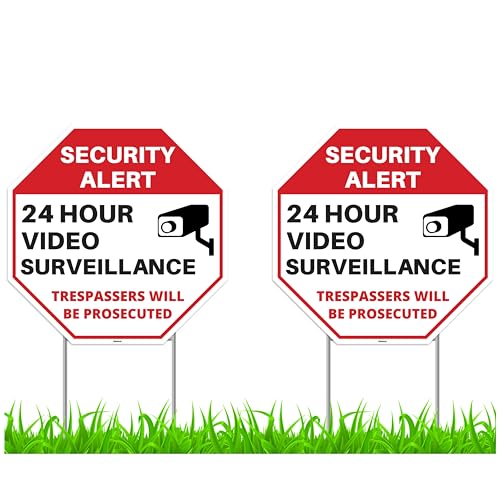
Venicor 24 Hour Video Surveillance Sign with Stakes, 12x12 inch, 2 Pack
$13.99Two signs, because a single sign at the front says nothing to anyone approaching from the rear.
Check price on AmazonPrices change often.

WaaHome Video Surveillance Sign 8x12 inch with Stake
$9.99The cheapest compliant notice here, for a reader who needs several.
Check price on AmazonPrices change often.

REOLINK 8CH 4K Security Camera System with 2TB HDD RLK8-800B6
$755.99Six 4K bullet cameras on an eight channel PoE recorder with a 2TB drive already fitted, which is the configuration most three bedroom homes land on after doing the entry point count.
- Channels
- 8
- Cameras included
- 6
- Resolution
- 8 MP
- Drive included
- 2 TB
Prices change often.
Common questions
Is it legal to have a security camera pointed at the street?
In most US jurisdictions, a camera aimed at your own property that incidentally captures a public street or sidewalk in the background is not a problem, since a street has little expectation of privacy. The distinction is between a wide view that includes the street and a camera deliberately trained on a public area or a neighbor's property as its main subject. Check your own local rules if you are unsure.
Can I point a camera at my neighbor's yard if they have complained about noise or theft?
A camera pointed at your own property line is generally fine even if it happens to see part of a neighbor's yard, but deliberately aiming a lens at their yard, door, or windows to monitor them is a different matter and the kind of placement most likely to produce a real dispute or complaint. Reframe toward your own property and consider talking to the neighbor directly instead.
Do I need a sign saying my house is under video surveillance?
Some jurisdictions require visible notice of video surveillance, others do not, and landlords or HOAs sometimes add their own signage rules regardless of the underlying law. A small sign is inexpensive and removes any question about whether recording was covert, so it is a reasonable default even where it is not strictly required. Check your own local and building rules to be certain.
Is a camera in a guest bedroom ever acceptable?
No. Bedrooms carry a reasonable expectation of privacy regardless of who is staying in them, whether that is a family member, a houseguest, a lodger, or a domestic worker, and recording there can be a criminal matter rather than only a civil one. This applies to a room used temporarily by a guest just as much as to a permanent bedroom.
Does this page cover audio recording too?
No, audio is a separate legal question governed by wiretap and consent law rather than general privacy law, and it applies even to a camera whose video placement is entirely legal. See the audio recording guide for that distinction before you leave a camera microphone enabled by default.
Get the system planning sheet
The camera count, storage and PoE budget worksheet, plus the wiring checklist, as one printable page.
Keep going
Before you point a camera at anything. Aim cameras at your own property and your own boundary, never into a neighbour's windows or across their garden. Cameras in bedrooms, bathrooms, or anywhere else a person reasonably expects privacy are a serious legal problem, and that includes guests, lodgers and anyone who works in your home. Audio is legally different from video, many US states require the consent of every party to a recorded conversation, and several recorders capture audio by default, so check your own state before you enable it. Some places require visible notice that recording is taking place, and landlords and homeowner associations often impose their own rules on top. This is researched general information and not legal advice, and the law varies by state and by country.
And once it is installed. Change every default password, keep the firmware updated, and be clear with yourself about where the footage goes: a cloud camera means a third party holds recordings of your home, while a local recorder keeps them in your house. That is a genuine buying consideration, not a technicality.
This is researched general information about how camera placement and privacy typically interact, not legal advice, and rules vary by state and by country. Check your own jurisdiction before you mount a camera in a position you are unsure about.