How to Choose Security Camera Resolution
A 4K (8MP) camera has 3840 horizontal pixels versus 1920 for 1080p, exactly 2x, so it reaches any EN 62676-4 DORI distance at twice the range, not four times, even though it has 4 times the total pixel count.
Every home camera box now advertises a megapixel number, and shoppers assume more megapixels means seeing farther into the yard. That assumption breaks down as soon as you compare a 4K bullet camera against a 5MP dome side by side, because the number that actually drives distance is horizontal pixel count, not total pixel count, and the two do not move together the way the marketing implies.
EN 62676-4, the DORI standard used across the security industry, defines four fixed pixel-per-metre thresholds: detect, observe, recognise and identify. Those thresholds, combined with a lens's field of view, are what actually tell you how far a specific camera and lens combination can put a stranger's face on an evidential quality frame, and they are the only honest way to compare resolutions against each other.
| Resolution | Horizontal pixels | Vertical pixels | Megapixels |
|---|---|---|---|
| 2MP (1080p) | 1920 | 1080 | 2.07 |
| 4MP (1440p) | 2560 | 1440 | 3.69 |
| 5MP | 2592 | 1944 | 5.04 |
| 6MP | 3072 | 2048 | 6.29 |
| 8MP (4K) | 3840 | 2160 | 8.29 |
| 12MP | 4512 | 2512 | 11.33 |
| Resolution | Identify distance | Detect distance |
|---|---|---|
| 2MP (1080p) | 13.8 ft | 137.8 ft |
| 4MP (1440p) | 18.4 ft | 183.7 ft |
| 5MP | 18.6 ft | 186.0 ft |
| 6MP | 22.1 ft | 220.5 ft |
| 8MP (4K) | 27.6 ft | 275.6 ft |
| 12MP | 32.4 ft | 323.8 ft |
Why does megapixel count mislead buyers?
A camera's resolution is really two numbers, horizontal pixels and vertical pixels, multiplied together to get the megapixel figure on the box. Doubling both dimensions quadruples the megapixel count but only doubles the horizontal pixel count, and it is the horizontal count that determines how many pixels fall across a person standing at any given distance.
That is why an 8MP (4K) camera is routinely described as having 4 times the resolution of 1080p, when for the purpose of distance it only has 2 times the horizontal pixels, 3840 against 1920. The extra pixels beyond that ratio go into vertical detail and file size, not into reach.
Aspect ratio adds to the confusion. Most of these sensors record in a 16:9 or 4:3 frame, so the vertical pixel count mostly determines how much sky or ceiling ends up in the shot rather than how far the camera can identify a face straight ahead. A tall, narrow porch scene and a wide, flat driveway scene both want to maximize horizontal pixels for distance, they just crop the vertical framing differently to fit the space.
What do the DORI detect, observe, recognise and identify levels mean?
EN 62676-4 defines four thresholds in pixels per metre of scene width, not pixels on the sensor: 25 ppm to detect that something is there, 62.5 ppm to observe clothing and behaviour, 125 ppm to recognise someone already known, and 250 ppm to identify a stranger to an evidential standard.
Those thresholds do not care about brand or price. Two completely different cameras that deliver the same pixels per metre at the same distance meet the same DORI level, which is why the standard is a fairer comparison tool than a megapixel sticker on a box.
- Detect, 25 pixels per metre: something is there, and it is a person rather than an animal or a shadow.
- Observe, 62.5 pixels per metre: clothing and behaviour are visible.
- Recognise, 125 pixels per metre: you can tell whether this is someone you already know.
- Identify, 250 pixels per metre: a stranger can be identified from the footage to an evidential standard.
How far can a 4K camera actually identify a face?
Take an 8MP (4K) camera on a common 2.8 mm lens and a 1/2.8 inch sensor. That combination works out to an 84.9 degree horizontal field of view, using hfov = 2 x atan(sensor width / (2 x focal length)).
Run that field of view and the 3840 horizontal pixels through the DORI distance formula and the camera identifies a stranger to an evidential standard out to about 27.6 ft, while it can still detect that a person is present out to about 276 ft. The gap between those two numbers, roughly 10 times, is why a driveway camera that clearly catches motion at the street rarely produces a usable face at that same distance.
Does digital zoom improve resolution or distance?
No. Digital zoom crops and enlarges pixels that already exist in the frame, it does not add new pixels from the scene, so it cannot change the pixels-per-metre value at any distance. A digitally zoomed still from a 1080p camera has exactly the same DORI distance as the same still viewed at full frame.
Only two things move the DORI distance for a fixed camera body: recording at a higher native resolution, or fitting a longer focal length lens that narrows the field of view and puts more of the existing pixels onto a smaller slice of the scene.
Which resolution fits a driveway camera versus a face level porch camera?
A porch or doorbell position is close range by definition, usually 6 to 12 ft to a visitor's face, so even a 2MP (1080p) camera on its stock lens comfortably clears the 250 ppm identify threshold at that distance. Spending on a higher resolution there mostly buys headroom for cropping later, not a functional distance gain.
A driveway or street facing camera is a different problem: the target is often 40 to 80 ft away, well past what a wide 2.8 mm lens on any resolution can identify. There, a higher resolution and a longer lens working together do the job that resolution alone cannot.
How does resolution change storage and bandwidth?
Higher resolution frames cost more to store and more to upload, by convention rather than by a fixed law. A typical sustained H.265 bitrate runs about 2 Mbps for 2MP, 3 Mbps for 4MP, 4 Mbps for 5MP, 6 Mbps for 8MP (4K) and 8 Mbps for 12MP, and every 1 Mbps of sustained bitrate works out to about 450 MB per hour of recording.
Doubling the horizontal pixel count for a meaningfully longer DORI distance roughly triples the bitrate going from 2MP to 8MP, which is worth planning for on the storage and bandwidth calculators before committing an entire system to 4K cameras.
The bitrate figures above assume H.265, sometimes labeled HEVC on a spec sheet. H.264, the older codec, needs roughly double the bitrate for the same picture quality at the same resolution, so a system with older cameras or an older NVR that only supports H.264 should budget storage and upload bandwidth accordingly rather than reusing the H.265 numbers above.
What resolution should most homeowners actually buy?
For entry points inside 15 ft, 2MP to 4MP paired with the camera's stock wide lens already clears the identify threshold and keeps storage modest. For anything covering a driveway, street, or open yard beyond about 30 ft, 5MP to 8MP paired with a longer lens, not a wider one, is what actually buys back the distance a low resolution loses.
Buying 12MP across an entire system rarely changes the outcome unless every camera is also paired with the longer lens needed to put those extra pixels on a distant target, and it multiplies storage and bandwidth cost across every channel on the recorder.
Resolution does not have to be uniform across a property. Running a modest 2MP or 4MP camera on close entry points and reserving 8MP or higher for the one or two cameras covering real distance, a driveway, a gate, a back fence line, keeps the total storage and bandwidth bill close to what an all-2MP system would cost while still buying the reach that actually matters.
The gear that matches this answer

REOLINK RLC-810A PoE Security Camera, 4K Wired Outdoor
$84.99The default 4K PoE bullet in this catalog: person and vehicle detection on the camera itself, so alerts are not triggered by every passing shadow.
- Resolution
- 8 MP
- Lens
- 4 mm
- Storage
- PoE, needs an NVR or NAS
Prices change often.

REOLINK RLC-1212A 12MP Bullet Outdoor PoE Camera
$129.99Twelve megapixels on a single camera, which buys real DORI identify distance on the one approach where you actually need a face rather than a shape.
- Resolution
- 12 MP
Prices change often.

Amcrest 5MP IP PoE AI Camera with 49ft Color Night Vision, Outdoor Bullet
$74.99Colour night vision rather than infrared monochrome, which preserves clothing and vehicle colour, the two details a police report actually asks for.
- Resolution
- 5 MP
- Stated IR range
- 49 ft
Prices change often.

Amcrest UltraHD 4K 8MP Outdoor Bullet Security IP PoE Camera, 98ft NightVision
$94.95Amcrest publishes its IR range and its lens focal length in the listing, which is rarer than it should be and is what makes a coverage calculation possible before you buy.
- Resolution
- 8 MP
- Stated IR range
- 98 ft
- Lens
- 2.8 mm
Prices change often.
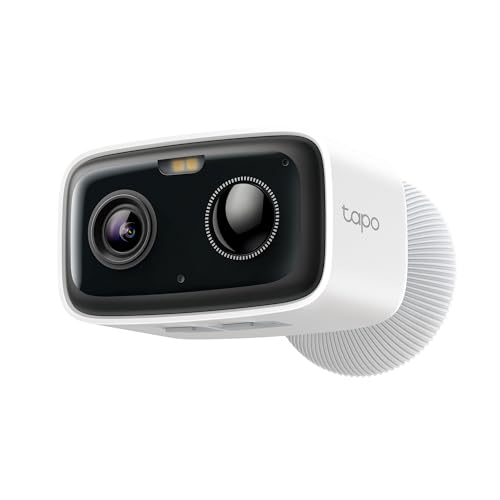
Tapo 1080p Outdoor Wireless Security Camera, Up to 180-Day Battery, C400
$44.99A very long battery life and local microSD storage, so it can run without a subscription.
- Resolution
- 2 MP
- Power
- Battery
- Storage
- microSD
Prices change often.

Ring Wired Doorbell 4K Pro with Wide-Angle Video
$249.99Four times the pixels of the 1080p doorbell, which is the only doorbell here that reaches identification standard at the far edge of a porch.
Check price on AmazonPrices change often.
Common questions
Is a 4K security camera always better than a 5MP one?
Not automatically. DORI distance depends on horizontal pixels and lens focal length together, not resolution alone. A 5MP camera (2592 horizontal pixels) with a longer lens can identify a face farther than a 4K camera (3840 horizontal pixels) on a wide lens, because the narrower field of view puts more of those pixels onto the same size target.
Does doubling resolution double how far a camera can identify someone?
No. DORI distance scales with horizontal pixel count, and going from 1080p to 4K only doubles the horizontal pixel count, from 1920 to 3840, even though the total pixel count quadruples. A camera that identifies a face at 14 ft in 1080p reaches about 28 ft in 4K on the same lens, not 56 ft.
Why does a wide angle lens hurt identification distance?
A wider field of view spreads the same number of horizontal pixels across a wider slice of the scene, which lowers pixels per metre at any given distance. A 2.8 mm lens covers a whole driveway but reaches roughly a third the identify distance of an 8 mm lens on the same sensor and resolution.
Is digital zoom a substitute for a higher resolution camera?
No. Digital zoom enlarges pixels that were already captured, it adds no new pixels from the scene, so the pixels-per-metre value at the original distance never changes. Only a higher native resolution or a longer optical lens actually improves how far a camera can identify a face.
What resolution is enough for a doorbell camera?
A doorbell camera sits a few feet from a visitor's face, well inside the identify distance of even a 2MP (1080p) sensor on its stock lens. Higher resolution mostly helps if the footage will be cropped or if the camera also needs to cover a wider porch or driveway view beyond the doorstep.
Get the system planning sheet
The camera count, storage and PoE budget worksheet, plus the wiring checklist, as one printable page.
Keep going
Before you point a camera at anything. Aim cameras at your own property and your own boundary, never into a neighbour's windows or across their garden. Cameras in bedrooms, bathrooms, or anywhere else a person reasonably expects privacy are a serious legal problem, and that includes guests, lodgers and anyone who works in your home. Audio is legally different from video, many US states require the consent of every party to a recorded conversation, and several recorders capture audio by default, so check your own state before you enable it. Some places require visible notice that recording is taking place, and landlords and homeowner associations often impose their own rules on top. This is researched general information and not legal advice, and the law varies by state and by country.
And once it is installed. Change every default password, keep the firmware updated, and be clear with yourself about where the footage goes: a cloud camera means a third party holds recordings of your home, while a local recorder keeps them in your house. That is a genuine buying consideration, not a technicality.
Match resolution to lens and distance together, since neither one alone determines what a camera can actually identify.