What a 8 mm security camera lens covers at 10 feet
A 8 mm lens on a 1/2.8 inch sensor has a horizontal field of view of 35.5 degrees, which covers a scene 6 feet wide (2 m) at a distance of 10 feet. That is about 2 average parking spaces, or the full width of a typical two car driveway only partly.
How this is worked out
scene width = 2 x distance x tan(horizontal field of view / 2), where field of view = 2 x atan(sensor width / (2 x focal length))
Sensor width is set by the optical format. The "1/2.8 inch" naming is a legacy convention from vidicon tubes rather than a real measurement, and the nominal width used here is 5.12 mm, which is the figure the industry uses for that format.
| Distance | Scene width | In metres | Roughly |
|---|---|---|---|
| 5 ft | 3.2 ft | 1 m | A doorway |
| 10 ft | 6.4 ft | 2 m | A single car |
| 15 ft | 9.6 ft | 2.9 m | A single car |
| 20 ft | 12.8 ft | 3.9 m | A two car drive |
| 30 ft | 19.2 ft | 5.9 m | A two car drive |
| 40 ft | 25.6 ft | 7.8 m | A small garden |
| 50 ft | 32 ft | 9.8 m | A small garden |
| 75 ft | 48 ft | 14.6 m | A small garden |
| 100 ft | 64 ft | 19.5 m | A wide frontage |
| Sensor | Horizontal pixels | Pixels per metre | DORI level reached | Good enough to |
|---|---|---|---|---|
| 2MP (1080p) | 1920 | 984 | Identify | A stranger can be identified from the footage to an evidential standard. |
| 4MP (1440p) | 2560 | 1312 | Identify | A stranger can be identified from the footage to an evidential standard. |
| 5MP | 2592 | 1329 | Identify | A stranger can be identified from the footage to an evidential standard. |
| 8MP (4K) | 3840 | 1969 | Identify | A stranger can be identified from the footage to an evidential standard. |
| 12MP | 4512 | 2313 | Identify | A stranger can be identified from the footage to an evidential standard. |
Choosing between coverage and detail
Every lens choice is the same trade. A 8 mm lens at 10 feet gives you 6 feet of width, and every extra foot of width costs pixel density on whatever is in the frame. There is no camera that avoids this, only sensors with more pixels to spread.
The practical approach on a real property is to stop trying to make one camera do both jobs. Use a wide lens for awareness across an open area, and put a second, longer lens on the one approach path where you genuinely need to identify a face. Two cameras doing one job each will outperform one camera compromising between them, and usually for less money.
Mounting distance is a design choice, not a constraint
The distance in this calculation is the distance from the camera to the subject, and it is often adjustable. Moving a camera closer to a gate rather than covering the gate from the house can transform what the footage is worth, and it is free.
The limit is usually cable, and the Ethernet channel limit of 100 metres is generous enough that camera placement is rarely constrained by it on a residential property.
Cameras with the reach for this distance
Optical zoom cameras first, because optical zoom is the only thing that adds pixels to a distant subject.

REOLINK RLC-823S1 4K PoE PTZ Camera, 5X Optical Zoom
$246.49Five times optical zoom multiplies pixels per metre at the far end of a drive by five, which no amount of sensor resolution on a fixed wide lens will do.
- Resolution
- 8 MP
- Optical zoom
- 5 x
Prices change often.
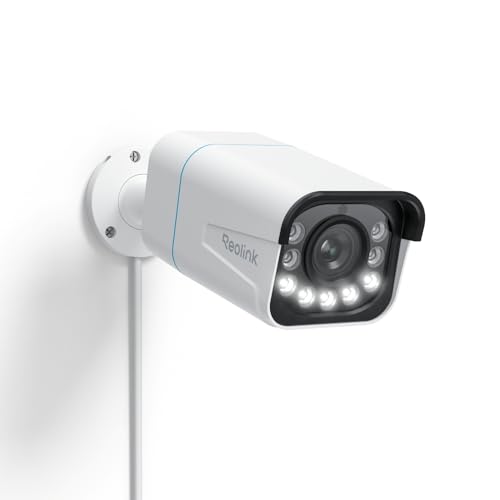
REOLINK RLC-811A PoE Security Camera, 5X Optical Zoom, 4K
$139.99The same five times optical zoom in a fixed bullet body rather than a motorised head, which is cheaper and has nothing in it that can seize.
- Resolution
- 8 MP
- Optical zoom
- 5 x
Prices change often.

REOLINK RLC-1212A 12MP Bullet Outdoor PoE Camera
$129.99Twelve megapixels on a single camera, which buys real DORI identify distance on the one approach where you actually need a face rather than a shape.
- Resolution
- 12 MP
Prices change often.

REOLINK TrackMix PoE Dual-Lens PTZ Security Camera, 6X Hybrid Zoom
$199.99Two lenses at once, one wide for context and one telephoto for detail, which resolves the usual argument between covering the whole drive and identifying anyone on it.
- Resolution
- 8 MP
Prices change often.

REOLINK E1 Outdoor SE PoE 4K Camera with Pan and Tilt
$119.99Pan and tilt on a small PoE body, useful where one camera has to cover two directions that are not adjacent.
- Resolution
- 8 MP
Prices change often.
Common questions
What field of view does a 8 mm security camera lens have?
About 35.5 degrees horizontally on a 1/2.8 inch sensor, which is the most common format in residential cameras. The same lens on a larger sensor gives a wider field of view and on a smaller one a narrower field, so the focal length alone does not determine coverage without knowing the sensor format.
How wide an area does a 8 mm lens cover at 10 feet?
About 6 feet, or 2 metres. Coverage scales linearly with distance, so at double the distance the same lens covers about 13 feet, with correspondingly fewer pixels landing on any person within it.
Should I choose a wide angle or a narrow lens?
Wide for awareness, narrow for evidence. A wide lens covers a whole area so you can see what happened, and a narrow lens puts enough pixels on a face to prove who did it. Most properties need both, placed on different approaches, rather than a single compromise lens that does neither job well.
What is a varifocal lens and is it worth it?
A varifocal lens can be adjusted across a focal range rather than fixed at one length, so the coverage can be tuned after the camera is mounted. It is worth the extra cost where you cannot predict the right framing in advance, which is common on a first install, and it removes the risk of buying a fixed lens that turns out to be wrong.
Get the system planning sheet
The camera count, storage and PoE budget worksheet, plus the wiring checklist, as one printable page.
Keep going
- Lens field of view calculator
- Camera spacing for full perimeter coverage
- DORI distance for a 4K camera on a 8 mm lens
- Field of view by focal length chart
- What a 8 mm security camera lens covers at 20 feet
- What a 6 mm security camera lens covers at 75 feet
- What a 8 mm security camera lens covers at 30 feet
- What a 16 mm security camera lens covers at 20 feet
Before you point a camera at anything. Aim cameras at your own property and your own boundary, never into a neighbour's windows or across their garden. Cameras in bedrooms, bathrooms, or anywhere else a person reasonably expects privacy are a serious legal problem, and that includes guests, lodgers and anyone who works in your home. Audio is legally different from video, many US states require the consent of every party to a recorded conversation, and several recorders capture audio by default, so check your own state before you enable it. Some places require visible notice that recording is taking place, and landlords and homeowner associations often impose their own rules on top. This is researched general information and not legal advice, and the law varies by state and by country.
And once it is installed. Change every default password, keep the firmware updated, and be clear with yourself about where the footage goes: a cloud camera means a third party holds recordings of your home, while a local recorder keeps them in your house. That is a genuine buying consideration, not a technicality.