PoE power budget for 12 class 4 cameras
12 class 4 cameras require a switch that budgets 360 W across 12 ports. The cameras themselves draw at most 306 W in total, but IEEE 802.3at requires the switch to reserve 30 W per port to cover worst case cable loss, so 360 W is the number to buy against. Allowing 20 percent headroom, look for a switch rated at least 432 W.
How this is worked out
required budget = cameras x PSE allocation for the class, then add headroom
The gap between the 30 W the switch reserves and the 25.5 W the camera can draw is the cable loss the standard assumes. Sizing a switch on the camera's own stated draw is the most common way to overcommit one, and the symptom is ports shutting down on the coldest night of the year when every heater runs at once.
| Class | Standard | Switch reserves per port | Camera may draw | Typical devices |
|---|---|---|---|---|
| Class 0 | 802.3af | 15.4 W | 12.95 W | Unclassified. The switch must assume a full 15.4 W. |
| Class 1 | 802.3af | 4 W | 3.84 W | Very low power devices. |
| Class 2 | 802.3af | 7 W | 6.49 W | Small fixed cameras. |
| Class 3 | 802.3af | 15.4 W | 12.95 W | Most fixed PoE cameras, including IR bullets and domes. |
| Class 4 | 802.3at | 30 W | 25.5 W | PoE+. Heaters, wipers, strong IR, small PTZ. |
| Class 5 | 802.3bt | 45 W | 40 W | PoE++ Type 3. |
| Class 6 | 802.3bt | 60 W | 51 W | PoE++ Type 3. Full size PTZ with heater. |
| Class 7 | 802.3bt | 75 W | 62 W | PoE++ Type 4. |
| Class 8 | 802.3bt | 90 W | 71.3 W | PoE++ Type 4. The ceiling of the standard. |
| Switch PoE budget | Required | Verdict | Spare capacity |
|---|---|---|---|
| 30 W | 360 W | Not enough | -1100 percent |
| 55 W | 360 W | Not enough | -555 percent |
| 65 W | 360 W | Not enough | -454 percent |
| 80 W | 360 W | Not enough | -350 percent |
| 120 W | 360 W | Not enough | -200 percent |
| 126 W | 360 W | Not enough | -186 percent |
| 150 W | 360 W | Not enough | -140 percent |
| 183 W | 360 W | Not enough | -97 percent |
| 250 W | 360 W | Not enough | -44 percent |
| 370 W | 360 W | Carries it | 3 percent |
Port count is not the specification that matters
An eight port PoE switch with a 60 W budget cannot run eight class 3 cameras, because those cameras need 123.2 W between them. This is the single most common mistake in a first install, and it is easy to make because the port count is on the front of the box and the budget is in the specification sheet.
Buy on total watts first, port count second. A switch with more ports than you need and a budget that covers them is cheap insurance, because the camera you add in two years is the one that pushes it over.
What a recorder with built in PoE changes
Many network video recorders include their own PoE ports, typically eight, and those have their own budget which is usually adequate for the cameras the recorder was sold with. If every camera plugs into the recorder, no separate switch is needed at all and this calculation applies to the recorder's budget instead.
The point at which a separate switch becomes necessary is when the camera count passes the recorder's built in port count, or when a camera is far enough away that it needs to join the network somewhere other than at the recorder.
Switches that carry this load
Ordered smallest adequate first, against the 360 W this configuration requires.
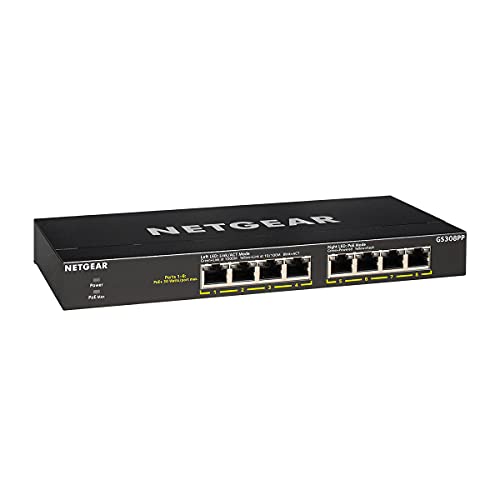
NETGEAR 8-Port PoE Gigabit Ethernet Unmanaged Network Switch GS308PP
$69.99An 83 W budget across eight PoE ports, which carries six to eight class 3 cameras with the headroom that stops a switch shutting a port down on a cold night when the heaters run.
- PoE ports
- 8
- PoE budget
- 83 W
- PoE standard
- 802.3af/at
Prices change often.

TP-Link 8 Port Gigabit PoE Switch, 8 PoE+ Ports at 126W
$89.99A 126 W budget is enough for eight class 3 cameras at their full standards allocation of 15.4 W each, with nothing left to chance.
- PoE ports
- 8
- PoE budget
- 126 W
- PoE standard
- 802.3af/at
Prices change often.

NETGEAR 16-Port PoE Gigabit Ethernet Unmanaged Network Switch GS316P
$135.75Sixteen ports with a 115 W budget, which suits a mixed system where not every port is a camera.
- PoE ports
- 16
- PoE budget
- 115 W
- PoE standard
- 802.3af/at
Prices change often.

NETGEAR 16 Port PoE Gigabit Ethernet Unmanaged Network Switch GS316PP
$159.99The same sixteen ports with a 183 W budget, which is what a genuinely full sixteen camera system needs.
- PoE ports
- 16
- PoE budget
- 183 W
- PoE standard
- 802.3af/at
Prices change often.

TP-Link TL-SG116P 16 Port Gigabit PoE Switch
$126.38Sixteen PoE ports at a lower price than the equivalent NETGEAR, with a 120 W budget that suits class 2 and class 3 cameras.
- PoE ports
- 16
- PoE budget
- 120 W
- PoE standard
- 802.3af/at
Prices change often.
Common questions
What size PoE switch do I need for 12 cameras?
For 12 class 4 cameras, a switch with at least 360 W of PoE budget and 12 powered ports. Allowing headroom for a camera that spikes or for a future addition, aim for around 432 W. Check the total budget in the specification rather than assuming the port count implies it, because the two are frequently mismatched.
What happens if the PoE budget is exceeded?
The switch stops powering ports rather than damaging anything. Most shed the highest numbered port first, or the lowest priority port if it is a managed switch, so one or more cameras simply go dark. Because budgets are most likely to be exceeded when heaters run in cold weather, the failure tends to arrive on the night the system is most needed.
Does cable length change the power budget?
Not the budget, but it changes how much of it reaches the camera. IEEE 802.3at already assumes worst case loss over a full 100 metre run, which is exactly why the switch reserves 30 W to deliver 25.5 W. Runs well under 100 metres lose less, but the switch still reserves the full allocation, so the budget calculation does not change.
Can I mix camera classes on one switch?
Yes, and most real systems do. Add the per class allocations together rather than multiplying one class by the total camera count. A system of six class 3 fixed cameras and two class 4 PTZ cameras needs the class 3 allocation six times plus the class 4 allocation twice, which is a noticeably larger figure than eight class 3 cameras.
Get the system planning sheet
The camera count, storage and PoE budget worksheet, plus the wiring checklist, as one printable page.
Keep going
Before you point a camera at anything. Aim cameras at your own property and your own boundary, never into a neighbour's windows or across their garden. Cameras in bedrooms, bathrooms, or anywhere else a person reasonably expects privacy are a serious legal problem, and that includes guests, lodgers and anyone who works in your home. Audio is legally different from video, many US states require the consent of every party to a recorded conversation, and several recorders capture audio by default, so check your own state before you enable it. Some places require visible notice that recording is taking place, and landlords and homeowner associations often impose their own rules on top. This is researched general information and not legal advice, and the law varies by state and by country.
And once it is installed. Change every default password, keep the firmware updated, and be clear with yourself about where the footage goes: a cloud camera means a third party holds recordings of your home, while a local recorder keeps them in your house. That is a genuine buying consideration, not a technicality.