Security Camera Resolution Comparison
From 2MP (1920x1080) to 12MP (4512x2512), pixel count roughly quadruples, from 2.07 to 11.33 megapixels. On the same 4 mm lens, that raises the EN 62676-4 identify distance from 6.0 metres at 2MP to 14.1 metres at 12MP, while typical H.265 storage need per camera roughly quadruples too.
Megapixel count is a marketed, standard figure, published pixel dimensions rather than an estimate. What that count buys in practice, DORI distance, storage need, and bandwidth, depends on how it is used, which is why this comparison pairs each resolution with its horizontal pixel count, a fixed-lens DORI distance, and a storage cost.
Bitrate and the resulting storage figures below are industry convention, not a fixed standard; real bitrate varies with scene content as described on the bitrate chart. The pixel dimensions and DORI distances are computed directly from published resolution specs and standard lens geometry.
| Resolution | Pixel dimensions (H x V) | Megapixels | Typical H.264 | Typical H.265 |
|---|---|---|---|---|
| 2MP (1080p) | 1920 x 1080 | 2.07 MP | 4 Mbps | 2 Mbps |
| 4MP (1440p) | 2560 x 1440 | 3.69 MP | 6 Mbps | 3 Mbps |
| 5MP | 2592 x 1944 | 5.04 MP | 8 Mbps | 4 Mbps |
| 6MP | 3072 x 2048 | 6.29 MP | 10 Mbps | 5 Mbps |
| 8MP/4K | 3840 x 2160 | 8.29 MP | 12 Mbps | 6 Mbps |
| 12MP | 4512 x 2512 | 11.33 MP | 16 Mbps | 8 Mbps |
| Resolution | Detect | Observe | Recognise | Identify |
|---|---|---|---|---|
| 2MP (1080p) | 60.0 m | 24.0 m | 12.0 m | 6.0 m |
| 4MP (1440p) | 80.0 m | 32.0 m | 16.0 m | 8.0 m |
| 5MP | 81.0 m | 32.4 m | 16.2 m | 8.1 m |
| 6MP | 96.0 m | 38.4 m | 19.2 m | 9.6 m |
| 8MP/4K | 120.0 m | 48.0 m | 24.0 m | 12.0 m |
| 12MP | 141.0 m | 56.4 m | 28.2 m | 14.1 m |
| Resolution | Days per TB, H.264 | Days per TB, H.265 |
|---|---|---|
| 2MP (1080p) | 21.5 | 43.1 |
| 4MP (1440p) | 14.4 | 28.7 |
| 5MP | 10.8 | 21.5 |
| 6MP | 8.6 | 17.2 |
| 8MP/4K | 7.2 | 14.4 |
| 12MP | 5.4 | 10.8 |
Is more resolution always worth the extra storage?
It depends on what the camera is covering. A camera pointed at a wide driveway or a distant gate benefits from more pixels because more horizontal pixels directly raise DORI distance on the same lens. A camera pointed at a close, narrow spot like a front porch may already meet the identify threshold at 2MP or 4MP, in which case the extra megapixels mostly add storage and bandwidth cost without a matching gain in usable detail at that specific distance.
How does resolution interact with lens choice?
Resolution and lens focal length work together to set DORI distance; neither alone determines it. Doubling horizontal pixels doubles DORI distance on a fixed lens, and switching from a wide to a narrow lens on a fixed resolution also increases DORI distance by narrowing the field of view. A budget camera with a well-chosen narrow lens can out-resolve a higher-megapixel camera stuck with too wide a lens for the distance involved.
The gear that matches this answer

Amcrest UltraHD 4K 8MP Outdoor Bullet Security IP PoE Camera, 98ft NightVision
$94.95Amcrest publishes its IR range and its lens focal length in the listing, which is rarer than it should be and is what makes a coverage calculation possible before you buy.
- Resolution
- 8 MP
- Stated IR range
- 98 ft
- Lens
- 2.8 mm
Prices change often.

Amcrest 5MP IP PoE AI Camera with 49ft Color Night Vision, Outdoor Bullet
$74.99Colour night vision rather than infrared monochrome, which preserves clothing and vehicle colour, the two details a police report actually asks for.
- Resolution
- 5 MP
- Stated IR range
- 49 ft
Prices change often.

REOLINK RLC-810A PoE Security Camera, 4K Wired Outdoor
$84.99The default 4K PoE bullet in this catalog: person and vehicle detection on the camera itself, so alerts are not triggered by every passing shadow.
- Resolution
- 8 MP
- Lens
- 4 mm
- Storage
- PoE, needs an NVR or NAS
Prices change often.
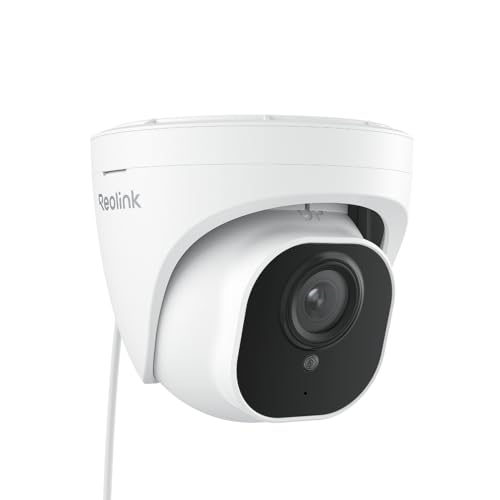
REOLINK RLC-820A 4K PoE Security Camera, Wired Outdoor Dome
$99.99The dome counterpart to the RLC-810A, same sensor and same detection, in a body that does not advertise which way it is looking.
- Resolution
- 8 MP
Prices change often.

Ring Wired Doorbell 4K Pro with Wide-Angle Video
$249.99Four times the pixels of the 1080p doorbell, which is the only doorbell here that reaches identification standard at the far edge of a porch.
Check price on AmazonPrices change often.
Common questions
What is the practical difference between 4MP and 5MP?
Very little in most residential use. 4MP (2560x1440) and 5MP (2592x1944) are close enough in horizontal pixel count, 2560 versus 2592, that DORI distance and image detail are nearly identical on the same lens, 8.0 metres versus 8.1 metres identify distance at 4 mm. The more meaningful jump in either DORI distance or fine detail comes from moving to 8MP/4K or choosing a longer focal length, not from the 4MP-to-5MP step itself.
Does 4K mean the same thing as 8MP?
On security cameras, yes, 4K is generally used as shorthand for the 3840x2160 pixel resolution, which multiplies out to 8.29 megapixels, close enough to be marketed as 8MP or 4K interchangeably. This differs slightly from cinema 4K (4096x2160), which is not the convention used in the consumer security camera market.
Why would someone choose a lower resolution camera on purpose?
Lower resolution cameras cost less to buy, use less storage per hour, and place less demand on network bandwidth, especially for cloud-upload or wireless battery cameras with limited uplink. For a spot where the DORI recognise or identify threshold is already met at 2MP or 4MP because the target distance is short, spending more on resolution mainly adds cost and storage without a usable gain in what can actually be seen.
Can two cameras with the same resolution number still perform differently?
Yes. Resolution only sets horizontal and vertical pixel count; DORI distance, actual image sharpness, low-light behaviour, and dynamic range all depend on the lens, the sensor's physical size, and the image processing pipeline behind it, none of which are captured by the megapixel figure alone. Two 4MP cameras can produce visibly different results at the same distance if their lenses or sensor sizes differ.
Does higher resolution cost more in upload bandwidth for cloud cameras?
Yes, proportionally to the bitrate increase shown in the typical bitrate columns above. A cloud-connected camera uploading continuously at 8MP/4K H.265 (6 Mbps) needs roughly three times the sustained uplink of the same setup at 2MP H.265 (2 Mbps). On a limited home internet uplink, this is often the practical ceiling on resolution well before storage or camera cost becomes the limiting factor.
Get the system planning sheet
The camera count, storage and PoE budget worksheet, plus the wiring checklist, as one printable page.
Keep going
Before you point a camera at anything. Aim cameras at your own property and your own boundary, never into a neighbour's windows or across their garden. Cameras in bedrooms, bathrooms, or anywhere else a person reasonably expects privacy are a serious legal problem, and that includes guests, lodgers and anyone who works in your home. Audio is legally different from video, many US states require the consent of every party to a recorded conversation, and several recorders capture audio by default, so check your own state before you enable it. Some places require visible notice that recording is taking place, and landlords and homeowner associations often impose their own rules on top. This is researched general information and not legal advice, and the law varies by state and by country.
And once it is installed. Change every default password, keep the firmware updated, and be clear with yourself about where the footage goes: a cloud camera means a third party holds recordings of your home, while a local recorder keeps them in your house. That is a genuine buying consideration, not a technicality.