How Many Channels Does Your NVR Need?
Buy at least one channel size above your current camera count, commonly 4, 8, 16 or 32 channels, because outgrowing a recorder's channel limit means replacing the whole recorder rather than simply adding a camera.
An NVR's channel count is the hard ceiling on how many camera streams it can ever record, and unlike a camera or a hard drive, it cannot be upgraded after purchase. Sizing it correctly the first time avoids buying a second recorder a year after the first one.
Channel counts on the market cluster around four fixed sizes, 4, 8, 16 and 32, and the practical rule is to buy one size above the number of cameras planned, not the number of cameras owned today.
| Channels | Typical household fit | Example use |
|---|---|---|
| 4 | A small home with one or two doors and a driveway camera | Front door, driveway, back door, garage |
| 8 | A typical single family home covering every ground floor entry point | All entry doors, driveway, backyard, side yard |
| 16 | A larger home, a detached garage, or a home combined with a small business | Whole perimeter plus interior cameras |
| 32 | A large property, multiple buildings, or a small commercial site | Main house, detached structures, gate, long perimeter run |
| Cameras today | Recommended NVR size | Spare channels |
|---|---|---|
| 3 | 4 | 1 |
| 4 | 8 | 4 |
| 6 | 8 | 2 |
| 7 | 8 | 1 |
| 8 | 16 | 8 |
| 12 | 16 | 4 |
What does an NVR channel actually limit?
Each channel is one camera input, one recorded stream, regardless of that camera's resolution. An 8 channel NVR records up to 8 separate camera streams at once and no more, whether those cameras are 2MP or 12MP, though a higher resolution on each channel does raise the total bandwidth and storage the recorder has to handle.
A PoE NVR kit also has a matching number of built in PoE ports, one per channel, while a standalone NVR sold without cameras may need a separate PoE switch or injectors to power the cameras plugged into its channels.
Some higher end NVRs also cap total incoming resolution or frame rate across all channels combined, a separate limit from the channel count itself, so it is worth checking a specific recorder's total throughput spec against the combined resolution of every camera planned for it rather than assuming any 8 channel NVR handles any 8 cameras equally well.
Why buy one channel size above the current camera count?
Outgrowing a recorder's channel limit means replacing the entire recorder, not simply adding a camera, because there is no channel expansion path on a fixed-channel NVR. A household planning 6 cameras that buys an 8 channel recorder can add 2 more cameras later for the price of the camera alone.
A household that instead buys the exact number of channels needed today has to repurchase an entire recorder, migrate every retained camera's cabling and reconfigure the whole system, for the sake of one additional entry point discovered after move in.
The math works the other direction too: a household that buys a 16 channel recorder for 4 current cameras has paid for capacity that may sit unused for years, so the one size up rule is meant to cover realistic near term growth, not to justify the largest available recorder regardless of actual plans.
What are the common NVR sizes and who they actually fit?
Recorders are almost always sold in 4, 8, 16 and 32 channel sizes rather than an arbitrary number, since that matches how PoE switches and camera kits are packaged. The table below matches typical household situations to each size.
Sizing also interacts with property type more than raw square footage. A single story ranch with four exterior doors and a detached shed needs a different channel count than a two story colonial with the same square footage but only two doors, since the entry point count, not the floor area, is what mostly drives camera count and therefore channel count.
Does a higher resolution camera use more than one channel?
No. Channel count is purely about the number of camera streams, not their resolution or bitrate. A single 12MP camera and a single 2MP camera each occupy exactly one channel on the recorder, though the 12MP stream consumes several times more storage per hour and more of the recorder's total processing and network throughput.
That distinction matters because a recorder can run out of total bandwidth or storage capacity before it runs out of channels if every channel is filled with a high resolution camera, which is worth checking against the storage days and upload bandwidth calculators before finalising a resolution choice across a full system.
This is the same reason two households with the same NVR model can have very different available recording days: one running every channel at 2MP with plenty of storage headroom, another running every channel at 12MP and filling the same drive in a fraction of the time. The NVR storage days calculator answers that question directly once camera count and resolution are set.
PoE NVR kit versus standalone NVR: what changes about channel planning?
A PoE NVR kit bundles a fixed number of channels, cameras and matching PoE ports together, which is simple but locks the buyer into that kit's exact channel count and included camera models. A standalone NVR is sold with channels only, letting the buyer mix camera brands and resolutions freely, at the cost of sourcing PoE power separately through a switch or injectors.
The one size up rule applies to both: a kit bought for the current camera count leaves no room to add a camera without buying an entirely separate recorder, while a standalone NVR bought one size up can simply take a new camera on its next free channel and PoE port.
Firmware and app ecosystem differences also show up here. A standalone NVR from one brand paired with cameras from several other brands can lose some manufacturer specific features, such as a proprietary AI detection category, that only work end to end within a single brand's kit. That tradeoff is worth weighing against the flexibility a standalone recorder otherwise provides.
How do you plan channel count for cameras added later?
List every current camera position, then add likely future positions before buying: a detached garage, a side gate, a basement entry, or a second driveway camera once the first one reveals a blind spot. Round the total up to the next standard channel size, not the current count.
Growth plans are easy to underestimate at move in, when the priority is usually just covering the obvious entry points quickly. Revisiting the list after living in the property through a full year, noticing which blind spots actually mattered, is a common point at which a household discovers it needs one or two more cameras than originally planned.
- Every entry door being covered today
- Any window, garage or gate likely to be covered within the next year or two
- A driveway or street facing camera if one is not already planned
- One spare channel per structure the property might add, a shed, a detached garage, a pool house
What else besides channel count limits future growth?
Total PoE power budget, measured against the switch or NVR's rated wattage, can run out before channels do, especially with cameras that draw more power for infrared illumination, heaters or pan-tilt motors. The PoE power budget calculator sums each camera's actual power class rather than its stated draw, since that is what a switch has to reserve.
Total recorder throughput and storage capacity are the other limits: a recorder with enough free channels can still choke on bandwidth if every added camera runs at 12MP, which is a separate ceiling from the channel count itself and worth checking before adding a high resolution camera to an already full recorder.
Cable run length is a third limit worth planning alongside channels and power: the 100 m Ethernet channel limit under ANSI/TIA-568 applies to every camera run regardless of how many free NVR channels remain, so a detached garage or a far corner of a large lot may need a PoE extender or a switch positioned partway along the run before an added camera can actually reach the recorder.
The gear that matches this answer

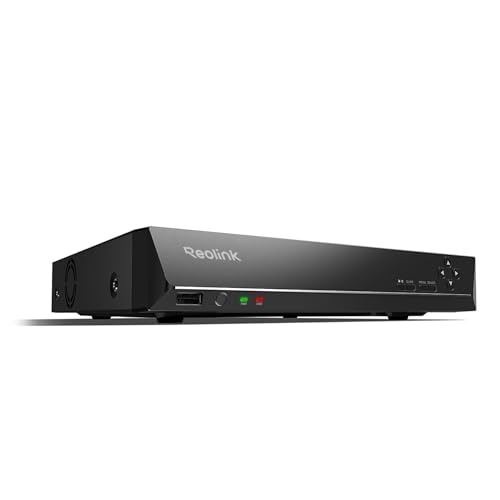
REOLINK RLN8-410 8CH NVR Network Video Recorder PoE
$349.99Eight PoE ports built into the recorder, so the cameras get power and data from the same box and there is no separate switch to budget.
- Channels
- 8
- PoE ports
- 8
Prices change often.
REOLINK RLN16-410 16CH NVR Network Video Recorder PoE
$459.99Sixteen channels for a property that has outgrown eight, and the usual reason to buy one is a detached garage or a second building.
- Channels
- 16
Prices change often.

ANNKE 12MP 8CH PoE Network Video Recorder, No HDD
$159.99Supplied without a drive, which is the cheaper path when you are fitting a surveillance drive sized from your own retention calculation rather than accepting whatever came in the box.
- Channels
- 8
- Resolution
- 12 MP
- PoE ports
- 8
Check first:No hard drive is included. Budget for a surveillance rated drive separately.
Check price on AmazonPrices change often.

TRENDnet 8-Channel UHD PoE NVR, TV-NVR1508
$107.99TRENDnet is a networking company rather than a camera company, and this recorder takes standards compliant cameras rather than locking to one brand.
- Channels
- 8
- PoE ports
- 8
Prices change often.

Lorex V-Series 4K 8-Ch 1TB Network Video Recorder
$399.99Ships with a 1TB drive already fitted, which is enough for four cameras for about two weeks and is a sensible starting point to expand from.
- Channels
- 8
- Drive included
- 1 TB
Prices change often.
Common questions
How many NVR channels do I need for 6 cameras?
Buy an 8 channel NVR rather than a 6 channel-equivalent option, since 8 is the next standard size up and leaves 2 free channels for cameras added later without requiring a second recorder purchase. Buying exactly 6 channels for 6 cameras leaves no room for a single additional camera.
Can I add more cameras than my NVR has channels?
No. Channel count is a fixed hardware limit with no expansion path on a standard NVR, so once every channel is filled the only way to add another camera is to replace the entire recorder. This is exactly why buying one size above the current camera count matters at purchase time.
Does a higher resolution camera take up more than one NVR channel?
No. One camera, at any resolution, occupies exactly one channel. A higher resolution camera does consume more storage and network bandwidth per hour than a lower resolution one on the same recorder, which can become a separate limiting factor even while channels remain free.
What is the difference between a PoE NVR kit and a standalone NVR for channel planning?
A PoE kit bundles a fixed channel count with matching cameras and built in PoE ports, simple but locked to that kit's size. A standalone NVR provides channels only, requiring separate PoE power through a switch or injectors, but lets the household mix camera brands and add cameras more flexibly over time.
Is a 16 channel NVR overkill for a typical house?
For most single family homes with 6 to 8 cameras, an 8 channel recorder with room to grow is usually enough, and 16 channels suits a larger property, a detached garage, or a home combined with a small business use case. Buying more channels than realistically needed mainly adds unused cost rather than unused risk.
Get the system planning sheet
The camera count, storage and PoE budget worksheet, plus the wiring checklist, as one printable page.
Keep going
Before you point a camera at anything. Aim cameras at your own property and your own boundary, never into a neighbour's windows or across their garden. Cameras in bedrooms, bathrooms, or anywhere else a person reasonably expects privacy are a serious legal problem, and that includes guests, lodgers and anyone who works in your home. Audio is legally different from video, many US states require the consent of every party to a recorded conversation, and several recorders capture audio by default, so check your own state before you enable it. Some places require visible notice that recording is taking place, and landlords and homeowner associations often impose their own rules on top. This is researched general information and not legal advice, and the law varies by state and by country.
And once it is installed. Change every default password, keep the firmware updated, and be clear with yourself about where the footage goes: a cloud camera means a third party holds recordings of your home, while a local recorder keeps them in your house. That is a genuine buying consideration, not a technicality.
Buy the next standard channel size above your planned camera count, not the exact number you own today.