Camera Mounting Height and Blind Spot Chart
A camera mounted 15 ft up and aimed at a point 15 ft away needs about 33 degrees of down-tilt, and with a 4mm lens that still leaves roughly an 11.4 ft blind spot directly beneath the camera, versus about a 14.4 ft blind spot from a 6 ft mount aimed at the same point.
Down-tilt angle and blind spot are both computed from the mount height, the distance to the point you are aiming at, and the camera's vertical field of view, using standard right-triangle geometry. Target height defaults to about 5 ft 3 in (1.6 m), a typical adult eye level, which is also what the calculator uses unless you change it.
The widely repeated guidance to mount a camera 8 to 10 ft up is a convention, not a physical law: it balances keeping the camera out of easy reach against keeping a walking adult's face large enough in frame to be useful. A camera mounted at 15 ft can still work, but it needs more down-tilt and a wider lens to avoid recording only the tops of heads.
| Mount height | Tilt at 10 ft distance | Tilt at 15 ft distance | Tilt at 20 ft distance |
|---|---|---|---|
| 6 ft | 4.3° | 2.9° | 2.1° |
| 8 ft | 15.4° | 10.4° | 7.8° |
| 9 ft | 20.6° | 14° | 10.6° |
| 10 ft | 25.4° | 17.6° | 13.4° |
| 12 ft | 34° | 24.2° | 18.7° |
| 15 ft | 44.3° | 33° | 26° |
| Mount height | Blind spot with a 2.8mm lens | Blind spot with a 4mm lens |
|---|---|---|
| 6 ft | 10.4 ft | 14.4 ft |
| 8 ft | 10.4 ft | 13.8 ft |
| 9 ft | 10.3 ft | 13.4 ft |
| 10 ft | 10.1 ft | 13.1 ft |
| 12 ft | 9.6 ft | 12.4 ft |
| 15 ft | 8.6 ft | 11.4 ft |
Why 8 to 10 ft is a convention, not a rule
Nothing in the standard defines a correct mounting height; it is a working compromise repeated across the industry because it tends to be above easy reach while still keeping a person's face at a usable size and angle in frame. A doorway with an overhang, a two-story wall, or a pole at a gate can all justify a different height, as long as the tilt angle and blind spot are worked out for that specific case rather than assumed.
What a blind spot is and why a higher mount does not remove it
Every camera has a bottom edge to its frame, and the ground between the wall and wherever that bottom edge lands on the ground is invisible to it. Mounting higher does not eliminate this zone; it changes its size and shape depending on how much the camera is tilted down to keep a distant point in frame. A camera aimed far out to cover a driveway can leave a larger dead zone right at its own base than a camera aimed closer in.
- The blind spot sits directly beneath the camera, between the wall and the ground.
- It shrinks as tilt angle increases relative to the vertical field of view.
- A camera aimed at a distant point trades a smaller far-field gap for a larger near-field one.
How lens field of view changes the blind spot
A wider lens has a larger vertical field of view for the same focal length and sensor, so its frame reaches further down toward the base of the wall at any given tilt angle, which shrinks the blind spot. A narrower, more zoomed-in lens sees a tighter vertical slice, which pushes its bottom edge further out and grows the blind spot, as the numbers in the table above show.
The gear that matches this answer

WiTi Universal Vertical Pole Mount for Security Camera, Metal Corner Bracket
$9.98Aiming a camera along a wall instead of perpendicular to it roughly doubles the useful coverage of a rectangular property.
Check price on AmazonPrices change often.
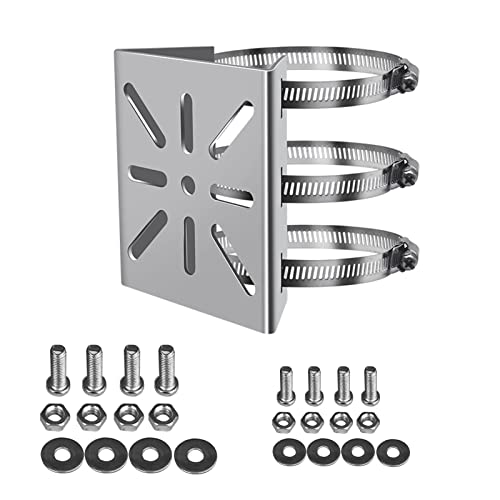
WiTi Universal Vertical Pole Mount for Security Camera, Stainless Steel
$12.99Stainless rather than painted steel, which is what a coastal or heavily salted location needs.
Check price on AmazonPrices change often.

ZT-NET Security Camera Corner Pole Mounting Bracket, Stainless Steel
$14.49A corner bracket that suits the smaller dome and turret bodies the larger mounts do not fit.
Check price on AmazonPrices change often.

compcctv Security Camera Mount Bracket, Aluminum Indoor Outdoor Wall Mount L-Type
$19.99Aluminium rather than plastic, for a camera that has to stay aimed through a winter of wind loading.
Check price on AmazonPrices change often.

VALUCAM PFA130-E Security Camera Wall and Ceiling Mounting Junction Box, IP66
$17.99An IP66 rating is a published ingress standard rather than a marketing word, and this is the pattern most Dahua and Amcrest bodies are designed to sit on.
Check price on AmazonPrices change often.
Common questions
Is 8 to 10 ft mounting height a real requirement?
No, it is a widely repeated industry convention rather than a published standard or a code requirement. It balances keeping a camera above easy reach against keeping a person's face large and clear enough in frame to be useful. A different height can work fine as long as the resulting tilt angle and blind spot are actually worked out for that specific mount rather than assumed to be fine.
What target height does this chart assume?
About 5 ft 3 in (1.6 m), a common average adult eye level, which is the default the underlying calculator uses for tilt angle. Aiming for a taller or shorter typical subject changes the ideal tilt angle slightly; the calculator lets you set a different target height if 1.6 m does not fit your situation.
Does mounting a camera higher always increase the blind spot?
Not necessarily, and the table above shows why: when a camera is re-aimed at the same distant point from a greater height, the extra down-tilt needed can partly offset the taller mount, sometimes shrinking the blind spot rather than growing it. The relationship depends on height, aim distance and lens field of view together, not height alone.
Why does a wider lens reduce the blind spot?
A wider lens has a larger vertical field of view, so at the same tilt angle its frame extends further down toward the wall's base, capturing ground that a narrower lens's frame would miss. That is why the 2.8mm column in the table above consistently shows a smaller blind spot than the 4mm column at every mount height.
What happens if the mount height is below the target height?
The tilt calculation returns no answer, because a camera mounted below the point it is aiming at is not a down-tilt problem at all, it needs to look up instead. That situation calls for a different placement or a different target point rather than a tilt angle from this formula, and this site will not force a number onto that case.
Get the system planning sheet
The camera count, storage and PoE budget worksheet, plus the wiring checklist, as one printable page.
Keep going
Before you point a camera at anything. Aim cameras at your own property and your own boundary, never into a neighbour's windows or across their garden. Cameras in bedrooms, bathrooms, or anywhere else a person reasonably expects privacy are a serious legal problem, and that includes guests, lodgers and anyone who works in your home. Audio is legally different from video, many US states require the consent of every party to a recorded conversation, and several recorders capture audio by default, so check your own state before you enable it. Some places require visible notice that recording is taking place, and landlords and homeowner associations often impose their own rules on top. This is researched general information and not legal advice, and the law varies by state and by country.
And once it is installed. Change every default password, keep the firmware updated, and be clear with yourself about where the footage goes: a cloud camera means a third party holds recordings of your home, while a local recorder keeps them in your house. That is a genuine buying consideration, not a technicality.